Pre-writing skills: 12 art games that prepare the hand for writing
Pre-writing skills are the set of movements a child uses to draw and, later, to write. At pre-school age they develop not through writing letters but through movement, which progresses from the shoulder through the elbow and wrist to the fingers. What helps most is big paper, drawing standing up, modelling, tearing and cutting. Below is an overview of what a child can usually do at each age, and 12 games to play at home.
Key takeaways
- The hand gets ready for writing from the shoulder: first big movements on a big surface, and only then the small movements of the fingers.
- The younger the child, the bigger the paper and the thicker the tool they need. A4 comes only in the final year of kindergarten.
- Drawing standing up at a wall, a board or an easel loosens the whole arm. Sitting at a table is the hardest position for a pre-schooler.
- The three-finger grip settles around the age of five. Not every child has mastered it before starting school.
- Kindergarten practises lines, arcs, wavy lines and loops, not letters.
- If your child avoids drawing because it wears them out, talk to their teacher or to a counselling and prevention centre (centrum poradenstva a prevencie, CPP).
What are pre-writing skills?
The specialist literature defines pre-writing skills (graphomotor skills) as the set of psychomotor activities a person performs when writing. In a pre-schooler they show mainly in drawing. In this article we draw mainly on the university textbook Rozvíjanie grafomotoriky v predškolskom veku (Developing Graphomotor Skills at Pre-school Age; B. K. Lehotayová, Comenius University, 2022).
They are often confused with two related terms. Fine motor skills are the dexterity of the small muscles of the hand, palm and fingers: doing up buttons, threading, cutting with scissors. Hand–eye coordination (visual-motor skills) is the eye and hand working together: the child judges distance and direction, and the hand goes where the eye is looking.
Pre-writing skills need both, along with the right sitting posture, a good grip on the tool and suitable pressure on the paper. They also rest on gross motor skills. That is because movement in drawing develops step by step: from the shoulder joint through the elbow and wrist to the palm and fingers.
The main advice of this whole article follows from that. Until a child’s shoulder and wrist are relaxed, small shapes on small paper are too hard for them. It starts with big movement.
What can a child usually do at each age?
The first scribbles come at around fifteen to eighteen months. At around two, the child starts to control them, and circular scribbles, dots and the first lines appear.
The textbook describes what comes next in four groups of pre-writing shapes. The authors it draws on point out themselves that the ages are approximate and that variation is natural.
| Age | What the child draws | Note |
|---|---|---|
| 3 to 4.5 years | What the child draws line, circle, dot, upper and lower arc, crossing lines | Note the vertical line from top to bottom comes before the horizontal one; then the child closes the line into a circle |
| 4 to 5.5 years | What the child draws spiral, slanted lines, wavy line, ellipse, zigzag (“teeth”), joined arcs | Note the wavy line needs both arcs, the “teeth” need the slanted line |
| 5 to 6.5 years | What the child draws loops, arcs with a return stroke | Note the upper loop is easier than the lower one |
| 6 to 7.5 years | What the child draws rising slanted stroke, heart-shaped stroke, upper and lower hook | Note not deliberately practised with children in kindergarten |
The table is not a test. It is there so that you do not expect loops from a four-year-old or letters from a five-year-old.
How should a child hold a pencil?
Grip develops as gradually as drawing does. Up to the age of two, a child holds the tool in the palm. Between two and three they grasp it with four fingers, in a loose fist. The three-finger grip, known as the tripod grip, appears as a settled habit around the age of five.
In the tripod grip, three slightly bent fingers hold the tool: the thumb, index finger and middle finger. The hand and fingers are relaxed and do not clench the tool. The index finger does not buckle, and the ring finger and little finger are loosely curled into the palm.
Not every child has mastered this grip before starting school. The textbook recommends telling two situations apart: an incorrect grip that has become fixed, and weak fine motor skills. In the second case, correcting the fingers does not help. Games that strengthen the fingers do.
The choice of tool helps too. A younger child finds a chunkier one easier to hold: a wax block crayon, thick chalk, a thicker coloured pencil, a sponge. The mark should be soft and broad, which is why soft 4B to 6B pencils are recommended. Triangular pencils are suitable. A felt-tip pen is not recommended for deliberate practice: it needs almost no pressure, so the child does not learn to control pressure.
Why does writing start at the shoulder?
Movement across a surface should come from the shoulder and elbow. The fine movements of the wrist and fingers come only after them.
So the rule is: the younger the child, the bigger the surface they need. Wrapping paper, a large sheet of drawing paper, a blackboard, sand. A smaller format is not recommended for younger pre-schoolers, and A4 suits only a dexterous child in the final year of kindergarten.
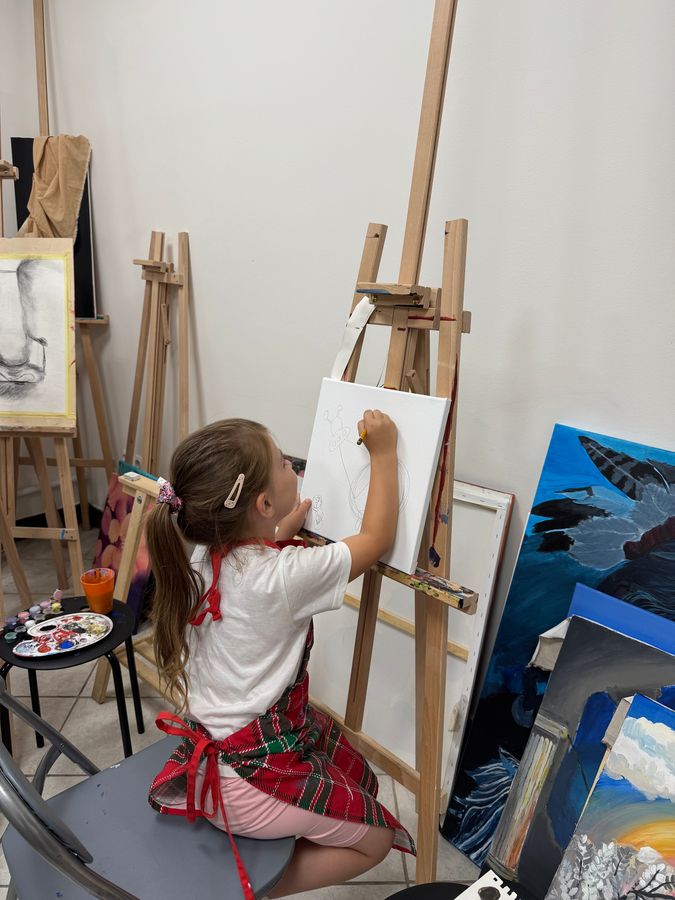
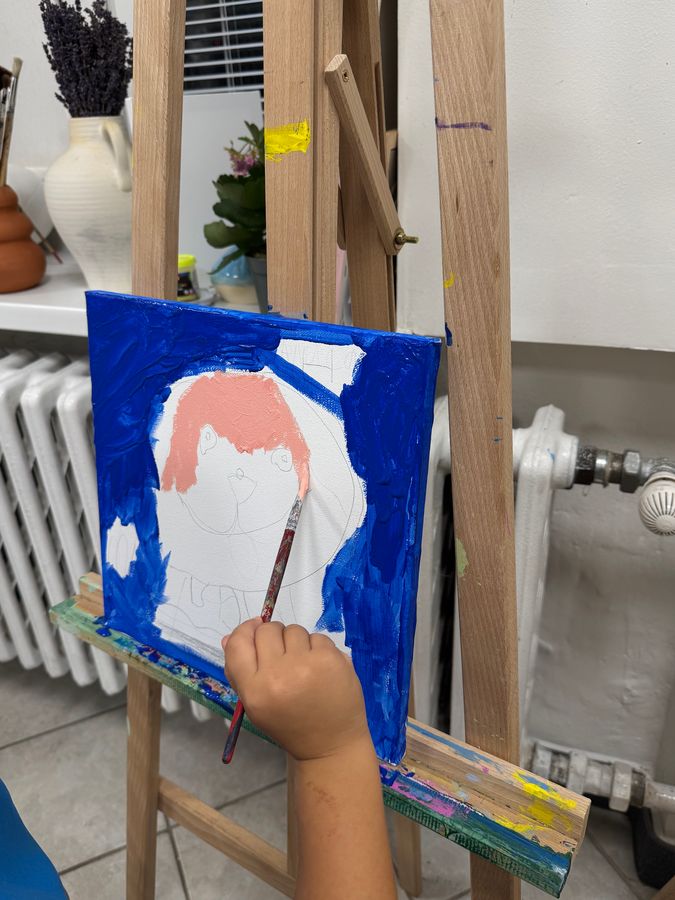
The second thing is position. Drawing at a vertical surface, standing or kneeling, allows bigger shoulder movements, loosens the whole arm and does not lock the wrist. A sheet of paper taped to a wall, a door or a piece of furniture is enough. The child should stand an arm’s length from the surface.
When it comes to keeping the arm relaxed, sitting at a table is the hardest position for a pre-schooler. That does not mean they should not draw at a table. It means the table and a small sheet of paper should not be the only option.
12 art games for pre-writing skills
The games are ordered the way the hand develops: from the shoulder to the fingers. The specialist literature recommends all the activities in them for loosening the hand and strengthening the fingers. They need nothing you would not have at home.
| Game | How to do it | What it trains |
|---|---|---|
| 1. Paper on the door | How to do it tape wrapping paper to a door; standing up, the child draws big circles, suns and rain with chalk or a wax block crayon | What it trains shoulder and elbow |
| 2. The house painter | How to do it a thick brush, one colour and a large sheet of paper on a wall or an easel; the child covers the surface with long strokes from top to bottom | What it trains shoulder, drawing a vertical line |
| 3. Chalk on the pavement | How to do it roads for toy cars, railway tracks and big puddles; the child squats to draw and moves the whole arm | What it trains shoulder and elbow, line and circle |
| 4. Drawing in flour | How to do it sprinkle flour or semolina onto a baking tray; the child draws lines and circles with a finger and wipes them away with a hand | What it trains wrist, drawing a line without pressure |
| 5. Sponge and finger paints | How to do it printing with a sponge and fingers on a large sheet of paper: leaves, snowflakes, the spots on a ladybird | What it trains palm and fingers, hand pressure |
| 6. The bakery | How to do it from plasticine, clay or dough the child rolls sausages, shapes balls and presses out flat cakes | What it trains palm, finger strength |
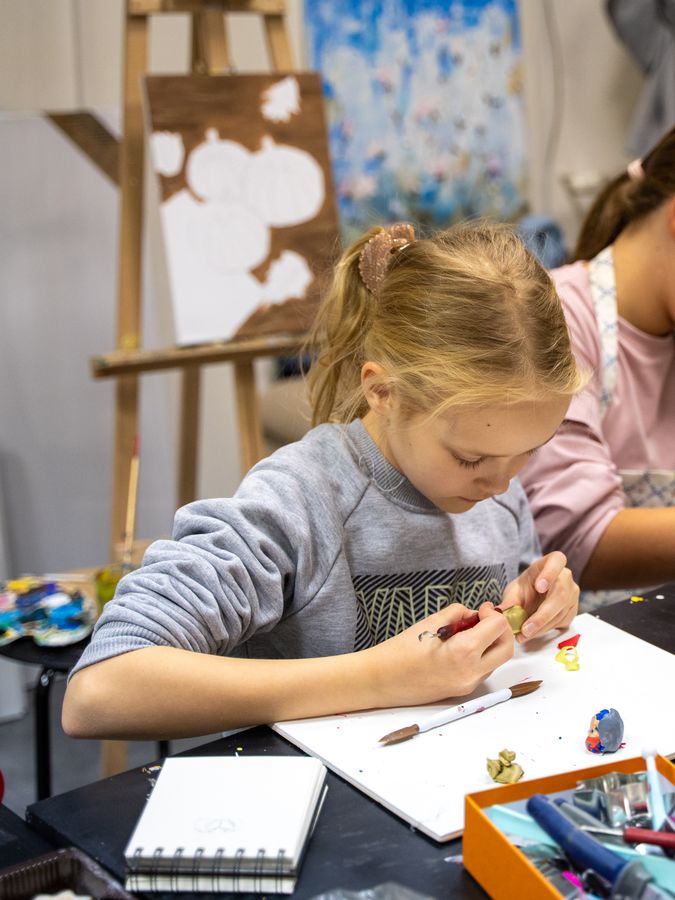
| 7. Pinching off | How to do it the child pinches small pieces off modelling clay and sticks them down to make a picture | What it trains thumb and index finger — the basis of the tripod grip |
| 8. Torn-paper collage | How to do it the child tears coloured paper into strips and pieces and glues them into a tree, a fish or the sea | What it trains fingers of both hands |
| 9. Scissors in four steps | How to do it first the child snips in the air, then cuts paper with no line, then between two lines and finally along a single line | What it trains fingers, hand–eye coordination |
| 10. Beads and pegs | How to do it the child threads large beads or pasta onto a string, and pegs drawings to a line with clothes pegs | What it trains pinch, precision |
| 11. Rain, grass, waves | How to do it on a large sheet of paper with a wax block crayon: rain from top to bottom, grass from the bottom up, waves on the sea, a crocodile’s teeth | What it trains line, wavy line, zigzag |
| 12. Loops to a song | How to do it on a large sheet of paper, in time with a song, the child draws smoke from a chimney, the wool on a sheep and a lying figure of eight | What it trains wrist, loop |
Choose by age. For a three-year-old, the first six games are enough. The loops in the last game are for five-year-olds and older.
Rhythm helps with drawing: a rhyme or a song. But the textbook points out that moving the hand in the air to a rhyme is not enough on its own to loosen it. A child needs to leave a mark on a surface.
And what about worksheets?
Worksheets are not bad. Their place is simply at the end of the road, not the beginning.
The sequence that specialist sources agree on is this: first big movement on a big surface, then pre-writing shapes in a large format, and only then a smaller format and tracing. Circles and arcs count as a loosening exercise only once the child does them automatically. While the child is still learning them, they do not loosen the hand.
So when you choose a worksheet, check two things. Whether the shape suits the child’s age — the table above will help. And whether the shapes on the sheet are big enough. If the child clenches their hand over the sheet, presses hard or avoids it, go back a step, to the big paper.
Letters are not a pre-school task. A child of pre-school age cannot yet copy joined-up letters, and kindergarten practises the shapes from which letters are later put together.
How should a child sit when drawing?
When the time comes for the table, check from the feet up: legs, trunk, arms, head.
The child sits relaxed, on the whole seat of the chair. The feet rest on the floor and the legs are bent at a right angle. The head is tilted slightly and is about 25 to 30 cm from the paper.
The chair and table should suit the child’s height. If the feet dangle, put a step stool or a thick book under them.
What if the child is left-handed?
A preference for one hand starts to show around the age of three to four. At five it is usually clear which hand is dominant, and hand dominance settles in the sixth, sometimes not until the seventh, year of life.
Do not retrain a left-handed child. Writing with the left hand is accepted and supported today. According to the textbook, retraining can lead to speech disorders and to difficulties with learning, writing and drawing.
There is one thing a left-handed child does need help with: direction. Left to themselves they may draw from right to left, but writing will go from left to right. Lines with an arrow and pictures laid out in a row from left to right help.
The grip is the same as a right-hander’s, only mirrored: the top end of the pencil points towards the left shoulder.
What is expected of a pre-schooler?
The Štátny vzdelávací program pre predprimárne vzdelávanie (Slovakia’s State Educational Programme for Pre-primary Education) has a section called Graphomotor Prerequisites for Writing, with four standards. The child draws pre-writing shapes that require movements of the palm and fingers. The child draws shapes that require movement of the wrist. When drawing, the child sits upright with the eyes at a suitable distance from the surface. The child holds the pencil correctly and presses on the surface with suitable force.
Among the shapes, the programme names vertical and horizontal lines, curves, loops, the upper and lower arc, the zigzag, the wavy line and the lying figure of eight. Not letters.
Enrolment in the first year of primary school takes place from 1 to 30 April. Every child who turns six by 31 August must be enrolled, whether or not they have reached school readiness. An assessment at a counselling and prevention centre before enrolment is not compulsory. This follows from the education ministry’s guidance on enrolment.
If a child has not reached school readiness after turning six, they continue in compulsory pre-primary education for one more school year. Pre-writing skills are one of several areas assessed in the process.
When should you consult a specialist?
In its material on school readiness, the education ministry lists the signs of weak pre-writing skills. The child holds the writing tool incorrectly. They sit hunched, with the head low over the paper and their body weight on the drawing hand. They cannot manage a loop. The line is shaky and the joins between lines are unsure. They draw slowly and avoid drawing because it wears them out.
With fine motor skills, notice whether the child can manage buttons, a zip, cutting, gluing and threading.
One sign on its own means nothing yet. If you see several and they persist, start with the kindergarten teacher, who sees the child every day. The next step is a counselling and prevention centre. It will also assess school readiness at a parent’s request, and a special education teacher and a psychologist work there.
We are an art studio, not a counselling service. We do not carry out assessments, and the art class is not therapy.
What does a weekly art class have to do with it?
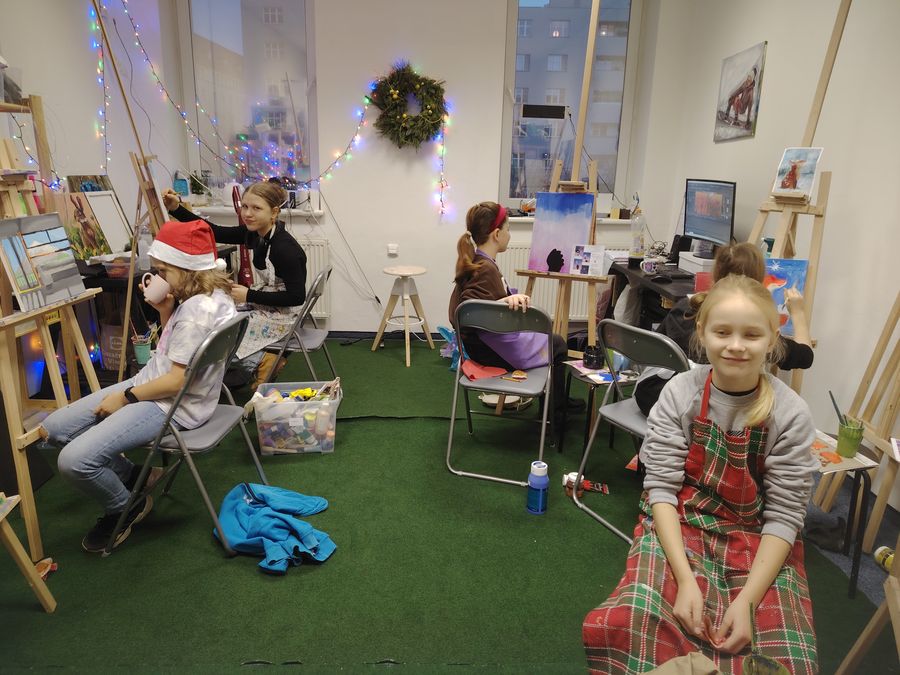
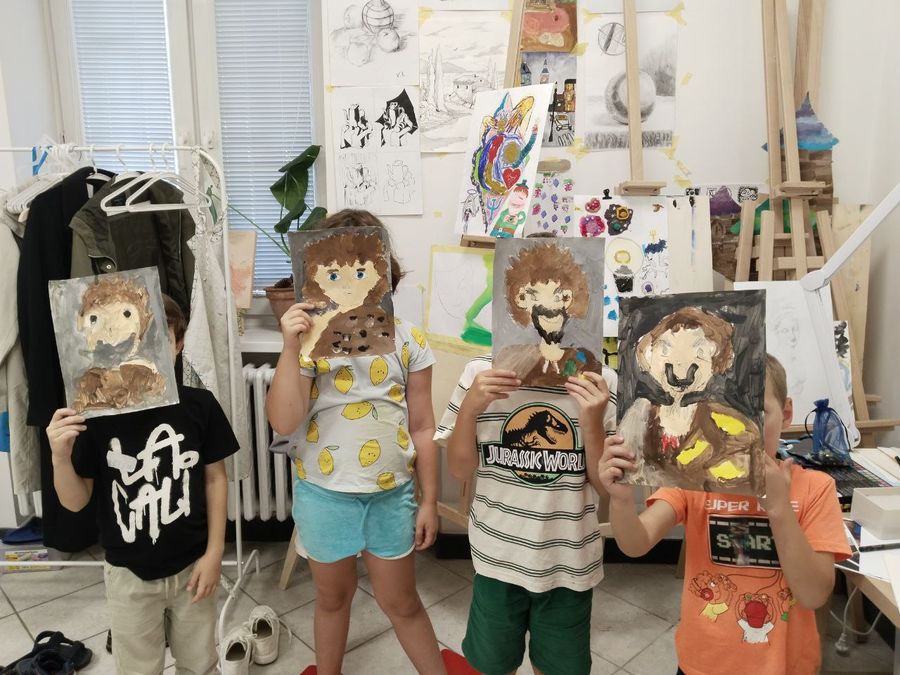
The class is not writing practice. But the children in it do what is recommended for loosening the hand: they paint at an easel, glue and model.
In the ARTIZO Kids studio at Radlinského 27, the group for the youngest is Little explorers, for children aged 5 to 7. It meets on Saturdays from 10 am to 12 noon. There are at most 8 children in the group. A lesson lasts 2 hours and materials are included.
The first lesson is free. After that, a single lesson costs €25 and a monthly subscription of 4 lessons costs €80.
We have no group for children under 5. The games in this article are for them. One-off afternoons with a teacher for older children are in the creative workshops calendar.
Parents’ questions
What are pre-writing skills?
The set of hand movements a child uses to draw and, later, to write. It also includes sitting posture, pencil grip and pressure on the paper.
From what age do pre-writing skills develop?
From the first scribbles, so from about a year and a half. In kindergarten, they are part of Slovakia’s State Educational Programme.
When should a child hold a pencil with three fingers?
The tripod grip settles around the age of five. Not every child has mastered it before starting school.
Are triangular pencils better?
They are suitable. What helps younger children most is a thicker tool and a soft mark: a wax block crayon, a thick coloured pencil, a 4B to 6B pencil.
Should a pre-schooler write letters?
No. In kindergarten, children practise lines, arcs, wavy lines and loops. Joined-up letters come in the first year of school.
Do pre-writing skills decide whether a child is admitted to school?
No. Every child who turns six by 31 August must be enrolled. Enrolment runs from 1 to 30 April.
My child switches between the right and the left hand. Is that a problem?
At three or four, no. The dominant hand is usually clear at five and settles in the sixth to seventh year of life. If your child is still switching hands just before starting school, talk to their teacher or a special education teacher.
From what age does ARTIZO Kids take children for the weekly art class?
From age 5. The Little explorers group is for children aged 5 to 7, and the first lesson is free.